
Nothing ruins a weekend project faster than running out of concrete halfway through a pour, or worse, buying way too much and watching your money sit in unopened bags. Whether you’re laying a patio, pouring a shed foundation, or finally tackling that cracked sidewalk, getting your concrete quantity right the first time saves you trips to the hardware store, wasted material, and a lot of frustration.
This calculator takes the guesswork out of your project. Just plug in your measurements, and you’ll know exactly how many bags to load in your truck.
Also, try Board Foot Calculator to Calculate Lumber Requirements)
Why Accurate Concrete Calculation Matters
Here’s the thing about concrete: you can’t just eyeball it. Unlike paint where you can always grab another gallon, concrete has a working window. Once you mix it, you’ve got about 90 minutes before it starts setting up. Running short mid-pour means cold joints, weak spots, and a slab that won’t hold up over time.
On the flip side, over-ordering isn’t just wasteful, it’s expensive. At $5-7 per bag, buying 20 extra bags means $100+ sitting in your garage. And once concrete absorbs moisture from the air, it’s basically garbage.
The sweet spot? Calculate your exact needs, then add a waste factor for spillage and uneven ground. That’s exactly what this tool does.
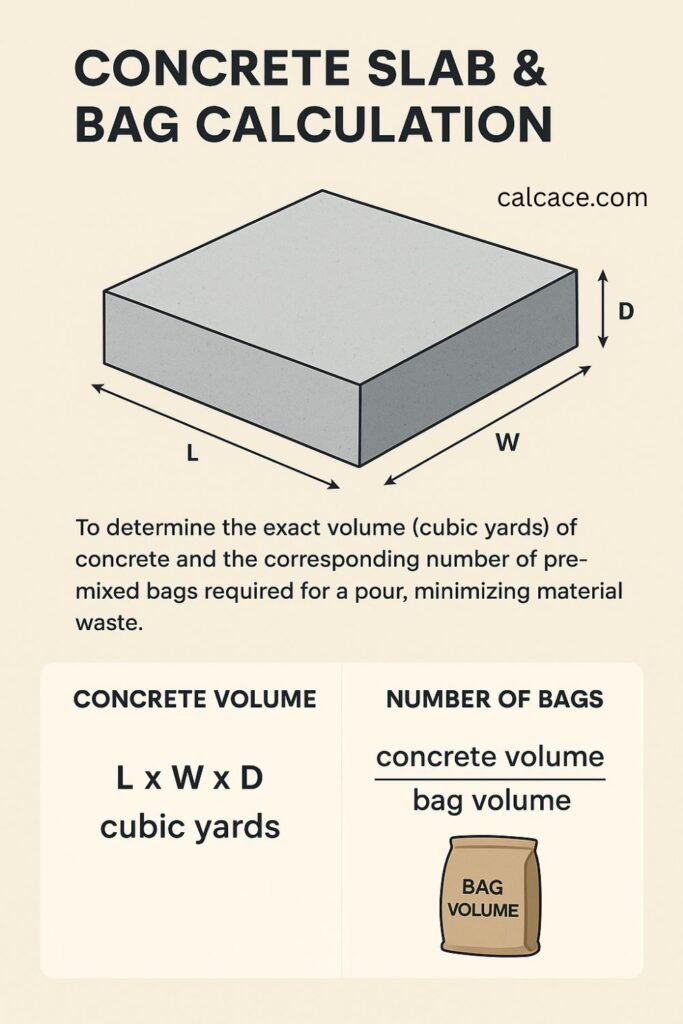
How to Use This Calculator
Step 1: Choose Your Shape
Most slabs are rectangular, but we’ve included circle and triangle options for those curved patios, round stepping stones, or odd corner fills. Pick the shape that matches your project.
Step 2: Enter Your Dimensions
Measure your area carefully. For rectangles, you need length and width. For circles, measure the diameter (the distance straight across). For triangles, measure the base and the height (perpendicular to the base).
Quick tip: measure in at least three spots if your ground isn’t perfectly level. Use the largest measurement to avoid coming up short.
Step 3: Enter Your Thickness
This is where people often go wrong. Standard sidewalks and patios need 4 inches minimum. Driveways and areas with vehicle traffic need 5-6 inches. Don’t skimp here—a too-thin slab will crack under pressure.
Step 4: Set Your Waste Factor
We recommend keeping the waste factor on, set around 10%. This accounts for spillage during mixing and pouring, uneven subgrade that eats up extra material, and concrete left stuck in the mixer or wheelbarrow. For perfectly prepped, level ground, you might drop to 5%. For rough terrain or your first pour, bump it to 15%.
Step 5: Check Your Results
You’ll see your total volume in both cubic yards and cubic meters, plus exactly how many bags you need in each common size. Pick the bag size that works for your project scale and physical comfort level.
Understanding Your Results
The calculator shows bag counts for 40lb, 50lb, 60lb, and 80lb options. Here’s how to choose:
| Bag Size | Coverage | Best For | Bags per Cubic Yard |
|---|---|---|---|
| 40 lb | 0.30 cu ft | Small repairs, post holes | 90 bags |
| 50 lb | 0.375 cu ft | Medium repairs, stepping stones | 72 bags |
| 60 lb | 0.45 cu ft | DIY slabs, most homeowner projects | 60 bags |
| 80 lb | 0.60 cu ft | Large projects, best value per pound | 45 bags |
For projects over 1 cubic yard, seriously consider ready-mix delivery. Mixing 45+ bags by hand is exhausting, and the timeline pressure increases your chance of mistakes.
Common Slab Thickness Guide
| Project Type | Minimum Thickness | Recommended |
|---|---|---|
| Garden pathway | 2 inches | 3 inches |
| Sidewalk | 4 inches | 4 inches |
| Patio | 4 inches | 4 inches |
| Shed foundation | 4 inches | 4-6 inches |
| Driveway (cars) | 4 inches | 5-6 inches |
| Driveway (trucks/RVs) | 5 inches | 6 inches |
| Garage floor | 4 inches | 6 inches |
Frequently Asked Questions
How much area does one 80lb bag cover?
One 80lb bag covers 0.6 cubic feet. For a 4-inch thick slab, that’s about 1.8 square feet of surface area—roughly a 16″ x 16″ square. It’s not much, which is why small slabs still need quite a few bags.
Can I pour concrete in sections if I run out?
Technically yes, but it’s not ideal. The joint between pours (called a cold joint) is always weaker than continuous concrete. If you must pour in sections, use a bonding agent and roughen up the edge of the existing pour before adding fresh concrete.
What’s the minimum thickness for a load-bearing slab?
Four inches is the minimum for foot traffic and light loads. Anything supporting vehicles needs 5-6 inches minimum, and you should include wire mesh or rebar reinforcement.
Does weather affect how much concrete I need?
Not the quantity, but definitely the process. Hot weather makes concrete set faster (less working time), while cold weather slows curing. Below 50°F, you’ll need special cold-weather precautions. Never pour on frozen ground.
Should I add gravel under my slab?
Yes, for most applications. A 4-inch gravel base provides drainage, prevents frost heave, and creates a stable foundation. This doesn’t change your concrete calculation, but it’s essential prep work.
How long before I can walk on new concrete?
Light foot traffic is usually safe after 24-48 hours. Wait at least 7 days before placing heavy objects, and a full 28 days before driving vehicles on a new driveway. Concrete reaches about 70% of its final strength at 7 days and full strength at 28 days.
What if my ground isn’t level?
Measure the depth at the deepest point and use that number. You’ll use more concrete than the simple calculation suggests, which is exactly why the waste factor exists. For significantly uneven ground, bump your waste factor to 15%.
Final Tips for a Successful Pour
Get everything ready before you mix that first bag. Have your forms set, your tools laid out, and a helper on standby if possible. Concrete waits for no one.
Consider renting a mixer for anything over 10 bags—your back will thank you. And always keep a few extra bags on hand. Unopened bags store fine for months in a dry location, and you’ll need them for the next project anyway.
Good luck with your pour!