
Planning a drywall project? Whether you’re finishing a basement, renovating a bedroom, or building from scratch, getting your material estimates right the first time saves you money, time, and frustrating trips back to the hardware store.
This calculator takes the guesswork out of your project by giving you exact quantities for drywall sheets, screws, joint compound, and tape—all while accounting for windows, doors, and the waste that inevitably happens on every job. Also, try Concrete Slab & Bag Calculator to Get the Exact Amount You Need
Why Accurate Drywall Estimation Matters
Here’s something most beginners learn the hard way: drywall projects almost always need more material than the “simple math” suggests. You cut around outlets. You make mistakes. Some pieces get damaged during transport. That’s just reality.
Professional contractors typically add 10-15% extra material to every estimate. This calculator does that automatically, so you’re not caught short halfway through your project with wet joint compound and no sheets left to hang.
How to Use the Calculator
Step 1: Enter Your Room Dimensions
Measure your room’s length, width, and ceiling height in feet. Don’t worry about being perfect—round to the nearest foot. For the length and width, measure at the base of the walls.
Quick tip: If your room isn’t a perfect rectangle, break it into sections and calculate each separately.
Step 2: Choose Your Sheet Size
Most residential projects use 4′ × 8′ sheets—they’re easier to handle and fit through standard doorways. But if you have high ceilings or want fewer seams, 4′ × 10′ or 4′ × 12′ sheets might be worth the extra effort.
Step 3: Add Your Cutouts
This is where most calculators fall short. Every window and door is material you don’t need to cover. Add each one with its width, height, and quantity. The calculator subtracts this area from your total, so you’re not buying sheets that end up in the dumpster.
Step 4: Set Your Waste Factor
Stick with 10% for straightforward rectangular rooms. Bump it to 15% or higher if you have lots of corners, angles, or if this is your first drywall project. There’s no shame in having extra—you can always return unopened materials.
Understanding Your Results
The calculator gives you a complete shopping list:
Drywall Sheets — The total number of full sheets you need, including waste allowance.
Screws — Drywall screws are sold by the pound or box (roughly 500 screws per 1-lb box). The calculator uses the industry standard of about 1.25 screws per square foot.
Joint Compound — Also called “mud,” this comes in 5-gallon buckets. You’ll use it for taping seams and finishing. The estimate covers multiple coats.
Tape Rolls — Paper or mesh tape for covering seams. One roll covers about 500 square feet of wall area.
Corner Bead — Metal or plastic strips that protect outside corners. These come in 8-foot lengths.
Drywall Sheet Reference Guide
| Sheet Size | Coverage Area | Best For | Weight (1/2″) |
|---|---|---|---|
| 4′ × 8′ | 32 sq ft | Standard rooms, DIY projects, easy handling | ~57 lbs |
| 4′ × 10′ | 40 sq ft | 9-10 ft ceilings, fewer horizontal seams | ~71 lbs |
| 4′ × 12′ | 48 sq ft | High ceilings, commercial work, pros only | ~85 lbs |
| Drywall Thickness | Common Applications |
|---|---|
| 1/4″ | Curved walls, layering over existing drywall |
| 3/8″ | Patches, repairs, low-traffic areas |
| 1/2″ | Standard walls and ceilings (most common) |
| 5/8″ | Fire-rated walls, garages, soundproofing, ceilings with 24″ joist spacing |
Frequently Asked Questions
How many sheets of drywall do I need for a 12×12 room?
For a standard 12′ × 12′ room with 8-foot ceilings (including ceiling coverage), you’ll need approximately 16-18 sheets of 4′ × 8′ drywall. This accounts for about 10% waste. The exact number depends on how many windows and doors you have.
Should I hang drywall horizontally or vertically?
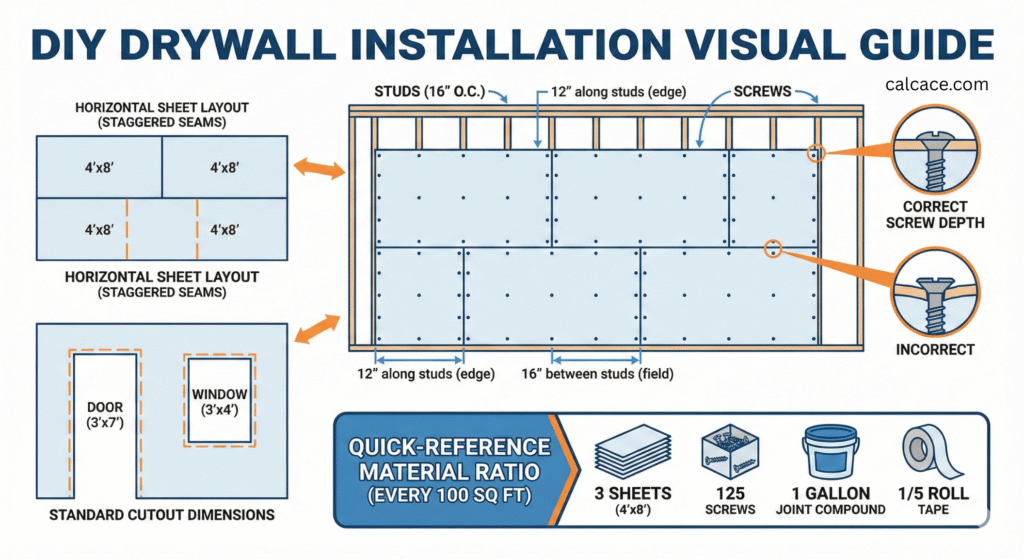
Horizontally is the professional standard for walls. It creates a stronger structure, reduces visible seams at eye level, and makes taping easier since horizontal seams are simpler to finish than vertical ones. For ceilings, run sheets perpendicular to the joists.
How much joint compound do I actually need?
Plan for roughly one gallon of joint compound per 100 square feet of drywall. This covers embedding tape, filling seams, and applying finish coats. Most DIYers find that one 5-gallon bucket handles a standard bedroom with some left over.
What’s the difference between green board and regular drywall?
Green board (moisture-resistant drywall) has a water-resistant facing and is meant for bathrooms, laundry rooms, and kitchens—anywhere humidity is high. It costs more but prevents mold and warping. Note: it’s not waterproof, so don’t use it in direct water contact areas like shower enclosures.
Can I install drywall by myself?
Walls? Absolutely. Ceilings? That’s tough without help or a drywall lift. A 4′ × 8′ sheet of 1/2″ drywall weighs nearly 60 pounds, and holding that overhead while driving screws is a recipe for frustration. Rent a lift or recruit a friend.
How long should I wait between coats of joint compound?
Let each coat dry completely—usually 24 hours, though “hot mud” (setting-type compound) dries faster. Rushing this step causes cracking, bubbling, and sanding nightmares. Touch the surface; if it feels cool or looks dark in spots, it’s still wet.
Why does my estimate include more screws than I expected?
The standard is one screw every 12 inches along studs, with studs spaced 16 inches apart. That adds up quickly. For a single 4′ × 8′ sheet, you’ll use around 28-32 screws. Having extras is better than running out mid-sheet.
Final Thoughts
Drywall installation is one of those jobs that looks simple until you’re standing in a room full of dust wondering why your seams look like speed bumps. Good planning makes all the difference.
Use this calculator before every project, double-check your measurements, and don’t skip the waste factor. The pros always buy a little extra—you should too.
Got questions about your specific project? The numbers from this calculator give you a solid starting point, but unusual room shapes or specialty installations might need adjustments. When in doubt, round up.