
Ever walked into a lumber yard with a budget, picked out your boards, and then felt your jaw drop at the register? You’re not alone. The difference between what you expected to pay and what you actually paid often comes down to one thing: board feet.
Unlike the simple “per piece” pricing at big box stores, hardwood lumber is sold by volume, and that volume is measured in board feet. Add in waste factors, milling fees, and premiums for wider boards, and suddenly that “simple” lumber purchase feels like you need a finance degree to understand.
This calculator cuts through the confusion. Enter your board dimensions, and you’ll see exactly how many board feet you’re buying, what the lumber yard might charge you (including those mysterious “fall-off” fees), and your total estimated cost, all broken down line by line. No more surprises at checkout.
Also, Check out our Snow Day Calculator.
What Is a Board Foot?
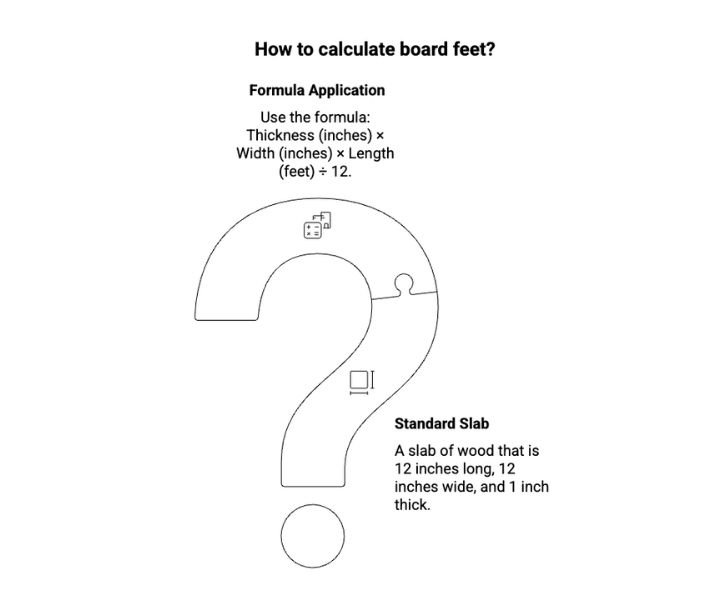
A board foot isn’t about length, it’s about volume. Think of it as a slab of wood that’s 12 inches long, 12 inches wide, and 1 inch thick. That’s 144 cubic inches of wood, or one board foot.
Here’s where it gets tricky: a board that’s 1 inch thick, 6 inches wide, and 8 feet long isn’t 8 board feet (even though it’s 8 feet long). It’s actually 4 board feet. The formula multiplies all three dimensions together.
The formula: Thickness (inches) × Width (inches) × Length (feet) ÷ 12
This is exactly why so many people get sticker shock. They see an 8-foot board priced at $8 per board foot and assume they’ll pay around $64. But if that board is 2 inches thick and 10 inches wide, they’re actually looking at 13.3 board feet—over $106.
How to Use This Calculator
Basic Calculation
- Enter the thickness – Use standard quarter notation (4/4, 8/4) or inches (1, 2). A 4/4 board is 1 inch thick, 8/4 is 2 inches thick.
- Enter the width – Measure the actual width in inches. You can use decimals (6.5) or fractions (6 1/2).
- Enter the length – Use feet and inches. An 8-foot board with 6 extra inches would be 8 ft and 6 in.
- Set the quantity – Buying multiple boards of the same size? Just increase the quantity instead of adding separate entries.
- Click the thickness preset buttons – These quickly set common hardwood thicknesses like 4/4, 5/4, 6/4, and 8/4.
The calculator instantly shows your board feet. Add more boards with the “Add Board” button to build up your full lumber list.
Understanding Lumber States
When you buy hardwood, it comes in different stages of processing:
Rough – Straight from the sawmill. The full nominal thickness. This is what most board foot calculations are based on.
S2S (Surfaced 2 Sides) – The top and bottom faces are planed smooth. You lose about 3/16″ of thickness.
S3S (Surfaced 3 Sides) – Two faces plus one edge are surfaced. Loses about 1/4″ thickness.
S4S (Surfaced 4 Sides) – All four sides are planed and smooth. Loses about 5/16″ thickness.
Here’s the catch: Most lumber yards charge you based on the nominal (rough) thickness, not the actual thickness you receive after surfacing. So that 8/4 board you’re buying as S2S? You’re paying for 2 inches of thickness but receiving about 1-13/16 inches.
Use the Nominal/Actual toggle to see the difference. If you want to calculate based on what you’re actually getting (not what you’re being charged for), switch to “Actual” mode.
The Waste Factor: Why Your Bill Is Higher Than Expected
This is where many woodworkers feel like they’re being overcharged—and honestly, the practice is confusing even when it’s legitimate.
When a lumber yard surfaces your boards, they remove material. That removed material is called “fall-off” or waste. Some yards build this cost into their per-board-foot price. Others charge you for the original board foot volume before surfacing, effectively making you pay for wood that ends up as sawdust.
The most common method is a waste multiplier. If a yard uses a 1.25 multiplier (or equivalently, “divides by 0.8”), they’re adding 25% to your board footage to account for milling waste.
Example: You calculated 10 board feet, but with a 1.25 waste factor, you’re charged for 12.5 board feet.
Is this fair? That depends on who you ask. The calculator doesn’t take sides—it just shows you exactly what’s happening so you can decide if the pricing makes sense for your situation.
Enter the waste multiplier in the Pricing & Fee Options section to see how it affects your total. If your lumber yard doesn’t use one (or already includes it in their price), leave it at 1.0.
Pricing and Fee Breakdown
Expand the Pricing & Fee Options section to get a complete cost estimate:
Price per Board Foot – The base rate your lumber yard charges. Prices vary widely by species, grade, and region. Walnut might run $12-15/BF while poplar could be $3-5/BF.
Waste/Fall-off Multiplier – Enter the multiplier your yard uses (commonly 1.25 or 1.33). The calculator will show you exactly how many “phantom” board feet are being added to your bill.
Milling Fee – Some yards charge separately for surfacing rather than using a waste multiplier. Enter this as a percentage of your material cost or as a flat rate per board foot.
Width Premium – Wide boards are harder to find and command higher prices. If boards over 8 inches wide cost extra at your yard, enter the threshold and additional cost here.
The results section breaks everything down: base board feet, waste additions, material cost, fees, and your total estimated price. Compare this to your lumber yard receipt to make sure the math adds up.
Planning Your Project with the Cutting List
Before you head to the lumber yard, figure out how much wood you actually need. Switch to the Cutting List tab and enter each piece in your project:
- Table top: 1″ × 24″ × 48″ (quantity: 1)
- Legs: 2″ × 3″ × 29″ (quantity: 4)
- Aprons: 1″ × 4″ × 32″ (quantity: 4)
The calculator totals up your net board feet—but here’s the important part: you can’t buy exactly what you need.
Wood has defects. Boards aren’t perfectly straight. You’ll make mistakes. Saw kerfs eat up material. You need to buy more than your cutting list requires.
The Waste Allowance percentage accounts for all of this. For straightforward projects with clear, straight-grained wood, 20% extra is usually enough. Working with figured wood, doing complex joinery, or just starting out? Budget 30-50% extra.
The calculator shows your net board feet, the waste allowance amount, and the total you should actually purchase. This number is what you take to the lumber yard.
Tips for Getting Accurate Results
Measure at the lumber yard. Board widths vary. That “6-inch” board might actually be 5-3/4″ or 6-1/4″. Measure each board and enter actual dimensions for the most accurate tally.
Ask about their pricing method. Before calculating costs, find out: Do they charge by nominal or actual thickness? Do they use a waste multiplier? Is there a milling fee? Is there a width premium? Enter these into the calculator before you shop.
Compare your tally to theirs. Mistakes happen. Workers rush. Boards get counted twice or dimensions get rounded. Bring your phone with the calculator open and compare your running total to what they ring up. Speaking up politely can save you money.
Round up for rough estimates. If you’re just budgeting, don’t worry about the inches. A 6-foot board calculated as 6’0″ versus the actual 6’3″ won’t break your budget. But when you’re tallying at the register, those inches matter.
Common Mistakes to Avoid
Confusing board feet with linear feet. This is the most expensive mistake. An 8-foot 8/4×8 board isn’t 8 board feet—it’s 10.67 board feet. Always calculate, never assume.
Forgetting the waste factor. If your lumber yard uses one and you don’t account for it, your estimate will be 20-30% too low.
Not budgeting project waste. Your cutting list says you need 20 board feet. You buy 20 board feet. You end up 3 board feet short and have to make another trip (and probably buy another full board). Always add waste allowance.
Assuming S4S costs the same as rough. You’re paying for the surfacing one way or another—either through a higher per-BF price, a waste multiplier, or a milling fee. Factor it in.
Take Control of Your Lumber Budget
The goal isn’t to catch lumber yards cheating—most are honest businesses with thin margins. The goal is to understand exactly what you’re paying for so there are no surprises.
When you know how board feet work, when you understand waste factors and milling fees, when you’ve calculated your project needs with proper allowances—you walk into the lumber yard confident. You know what to expect. You can compare prices accurately between yards. You can spot errors on your receipt.
That’s what this calculator gives you: clarity and confidence. Use it before every lumber run, and “sticker shock” becomes a thing of the past.